
Most UK SME leaders know AI matters. But with limited bandwidth, no dedicated tech team, and an overwhelming amount of noise, the real challenge is simpler than it sounds: where does AI really fit in my business? The answer is already inside your organisation, in the workflows your team runs every day.
Why most businesses struggle to start with AI
There is no shortage of AI advice aimed at business leaders right now. Tools to evaluate, vendors pitching, competitors announcing AI-powered this and that. But for most SME founders and senior leaders, people already stretched across operations, clients, and growth, very little of it translates into something they can put into practice.
Some teams are already using AI for certain tasks. Others have not gone beyond personal use, if they have started at all. And the gap between those two groups is growing wider every month.
According to the ONS Business Insights Survey, only 31% of small UK businesses currently use AI. The most common barrier is not cost or scepticism; it is uncertainty about where AI applies. 39% of UK SMEs say they simply do not know how AI fits their business.
This article provides a practical method to answer that question, in under a week, without specialist expertise.
What is a workflow audit for AI adoption?
A workflow audit is a structured, clear-eyed look at how your key business processes really operate: not on paper, not in the org chart, but in reality. It maps the steps, handoffs, people, and information flows involved in getting important work done.
For AI adoption, a workflow audit identifies the gap between how work happens today and the outcomes you really want, and pinpoints exactly where AI could help close that gap.
The approach is grounded in a principle I come back to again and again: start with your definition of excellent, then reverse-engineer from there.
HBR discusses the risks of leading with technology rather than business problems: Is Your AI-First Strategy Causing More Problems Than It’s Solving?
Why should SMEs start with workflows instead of AI tools?
This is something I feel strongly about, having spent a decade inside AI technology companies and another decade on IT transformation projects in commercial banking.
Technologists build things to solve problems, or at least their perception of problems. Putting technology into a business operation requires something different: change in habits, in skills, in mindset, in workflows. You need to identify your real problem, the root cause and business impact, the solution and outcome, and decide whether it is worth the investment in time, money, and resource.
When you start with the work itself, AI stops being a technology question and becomes a business improvement question. That reframe matters because business improvement is something every leader already knows how to think about.
I also want to be straight with you: AI is not a silver bullet. It will not fix a broken process by magic, and it will not deliver results without genuine investment in time, thought, and people. But when applied well, it makes good businesses measurably better. That is worth the effort.
What does “start with your definition of excellent” mean?
Most AI advice says “look for problems.” I put it differently.
Start with outcomes. What does excellent look like for the things that matter most in your business?
- What does a brilliantly handled client enquiry look like from first contact to signed agreement?
- What does a perfectly informed decision look like?
- What does it look like when your best people spend their time on work that really needs their brain?
Once you are clear on what excellent looks like, work backwards:
- What tasks and steps are needed to deliver that outcome?
- Where are the handoffs, dependencies, and decisions?
- Where is the gap between how things work today and that picture of excellent?
That gap, not a vendor’s feature list, is your real AI starting point.
McKinsey’s research reinforces this: AI adoption is most effective when grounded in outcomes and ways of working, not tool access alone: Reconfiguring work: Change management in the age of gen AI
The AI opportunity spectrum: automate, innovate, eliminate
A workflow audit reveals opportunities across three levels. I call this the AI opportunity spectrum, and it applies whether you are looking at a single task or reimagining an entire operation.
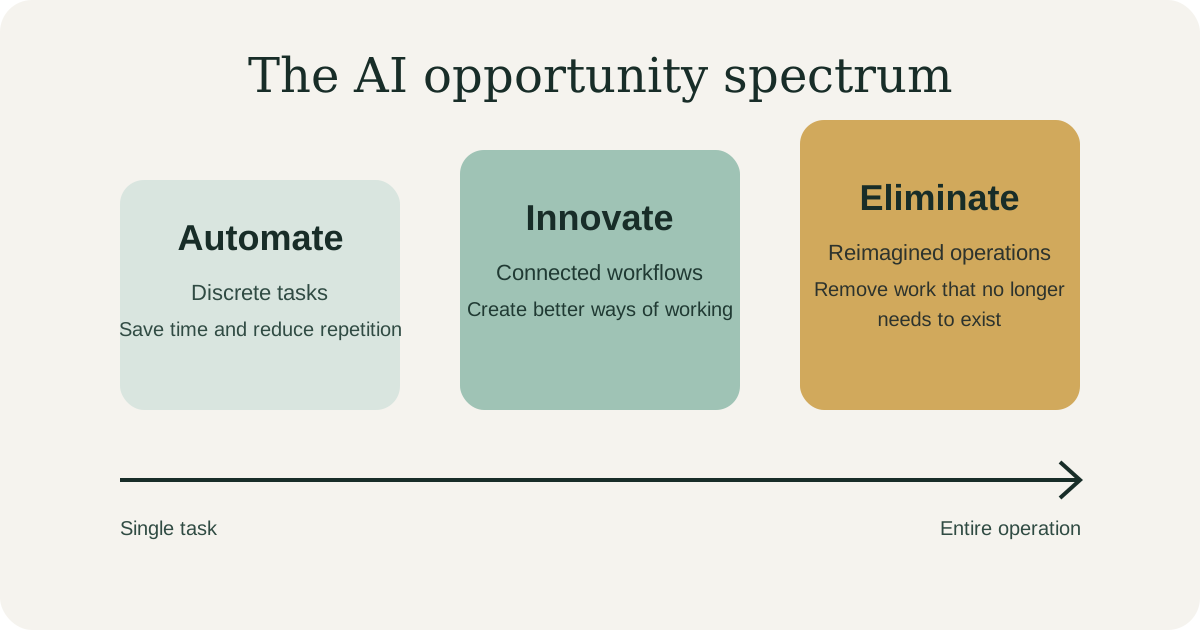
Automate
Make discrete, repeatable tasks faster and more consistent. First drafts, formatting, data gathering, summarising, scheduling. This is where most businesses start, and it is a perfectly good place to begin. Quick wins here build confidence and free up capacity for what comes next.
Examples: AI drafting client communications, meeting summaries, data extraction from documents, onboarding checklists.
Innovate
Help people think and decide better by getting the right information to them sooner. Surfacing patterns across client data. Stress-testing assumptions in a business case. Pulling together context someone needs before a decision rather than after it. This is not automation, it is augmentation. It can also open up new ways of serving clients or creating value.
Examples: Competitive analysis, scenario modelling, customer insight synthesis, proposal personalisation.
Eliminate
Remove work that should not exist. Rekeying data between systems. Approval chains that add delay but not value. Manual assembly of information that could flow automatically. Some of the biggest gains come not from making work faster, but from removing work that was only there because of old constraints.
Examples: Duplicate data entry, manual report assembly, unnecessary handoffs, information trapped in email threads.
Reimagine
At the far end of the spectrum, automate, innovate, and eliminate combine into something more significant: the chance to look at an entire process, or even a whole operation, and ask whether it should work this way at all. Not incremental improvement. Genuine reimagination. Most businesses have at least one process that was designed around limitations that no longer apply.
How to run a workflow audit in your business (step by step)
You do not need a consultant, a budget, or a free afternoon you do not have. Here is a practical method you can run this week.
Step 1: Choose three to five workflows that matter most
Focus on processes closest to revenue, client delivery, or the decisions that shape your direction. Common candidates I see across UK SMEs:
- Inbound enquiry to proposal
- Client onboarding
- Monthly reporting
- Customer support triage and response
- Recruitment screening and shortlisting
Step 2: Define what excellent looks like for each one
Write down the outcome you would want if everything worked the way it should. One or two sentences is enough.
Example: “Every new client enquiry gets a personalised, high-quality response within 4 hours, with all relevant information gathered before the first call.”
Step 3: Map how it works today
Write down the steps, the people involved, and the handoffs between them. One page per workflow. You are not creating a process diagram, you are making the invisible visible.
Step 4: Mark the gaps between today and excellent
Compare today’s reality against your picture of excellent. Identify the three biggest gaps: the spots where time, quality, or information is lost.
In my experience, look for:
- Bottlenecks everyone has worked around so long they have become invisible
- Decisions being made without the information that should inform them
- Capable people spending time on work beneath their skill level
Step 5: Apply the automate, innovate, eliminate lens
For each gap, ask:
- Could this be automated, made faster and more consistent?
- Could this be innovated, helping someone think, decide, or create value differently?
- Could this be eliminated, removed because it only exists due to old constraints?
Step 6: Write one outcome sentence per opportunity
Keep it measurable and human. This is the same Destination, Route, Vehicle principle.
“Reduce proposal turnaround from five days to two, while keeping quality consistent.”
“Cut time spent assembling monthly reports by 40%, freeing the senior team for analysis.”
“Get decision-relevant client data in front of account leads before the meeting, not after.”
MIT Sloan supports this approach: How to find the right business use cases for generative AI
What does a workflow audit typically reveal?
Having run this exercise across multiple sectors and company sizes, three patterns surface almost every time.
A hidden bottleneck with a real cost. There is usually one process, often involving approvals, information gathering, or internal communication, that quietly slows everything else down. People have adapted to it. But when you name it, measure it, and hold it against your picture of excellent, the opportunity is significant.
A judgement gap worth closing. Somewhere in the business, people are making important decisions without the information that should inform them, or spending hours manually assembling it. AI can close that gap, not by making the decision, but by getting the right context to the right person faster. This is what separates reactive decisions from well-informed ones.
Skilled people doing unskilled work. First-draft client communications, data formatting, meeting summaries, onboarding checklists, these are tasks where AI can handle 80% of the work and a person adds the final 20% of judgement, nuance, and tone. A practical operating rule: AI drafts, people decide.
Workflow audit template (copy and use)
Use this template as your starting point. One page per workflow.
WORKFLOW AUDIT STARTER

Workflow name:
Owner:
Teams involved:
Volume (per week):
Current cycle time:

WHAT DOES EXCELLENT LOOK LIKE?
(1–2 sentences describing the ideal outcome)

STEPS (as they really happen today)
1)
2)
3)
...

GAPS (top 3: between today and excellent)
- Step:
  What happens:
  Impact (time / cost / quality / risk):

AUTOMATE / INNOVATE / ELIMINATE (for each gap)
- Automate: Could this be faster and more consistent?
- Innovate: Could this help someone think or decide better?
- Eliminate: Could this be removed entirely?

OUTCOME SENTENCE
"I want to [measurable change] by [method],
so that [business benefit]."

NEXT STEP
What I will test this week:
Who owns it:
Frequently asked questions
Do I need technical knowledge to run a workflow audit?
No. A workflow audit is a business exercise, not a technical one. If you understand how work moves through your organisation, you can run one. The goal is to define what excellent looks like and find the gaps, no AI expertise required. If you want to learn more about the AI tools available, that comes later.
How long does a workflow audit take?
A lightweight version can be completed in under a week. Mapping a single workflow takes roughly 12 minutes. The full exercise, including prioritisation, can be done in a focused half-day session, which is exactly what I run in my Demystify to Deploy™ Workshop.
What if I have already bought AI tools?
A workflow audit is still valuable, arguably more so. It helps you understand whether the tools you have are pointed at the right problems, and often reveals higher-value opportunities your existing tools could already support. This is a common finding when I work with businesses that have invested in tools before building fluency.
Is this relevant to my sector?
I have run this across hospitality, professional services, construction, education, manufacturing, and financial services. The specific workflows differ (a law firm’s client intake versus a hospitality group’s guest communication), but the method (define excellent, map reality, find the gaps, apply the right lever) works across all of them.
Is AI worth the investment for an SME?
It takes time, thought, and commitment from the people involved. But you do not need a large budget to start, a focused pilot on one workflow can demonstrate real value within weeks. The ONS found that businesses adopting AI achieve 19% higher turnover per employee. The key is starting with a problem worth solving, not buying technology and hoping it sticks.
What is the difference between a workflow audit and an AI strategy?
An AI strategy tends to be top-down and technology-led: “how should we use AI across the business?” A workflow audit is bottom-up and outcome-led: “what does excellent look like for this specific process, and where could AI help us get there?” In my experience, the workflow audit produces a better AI strategy than trying to write one from scratch.
Why this work matters to me
I spent ten years working inside advanced AI companies, computer vision, multimodal voice assistants, multi-agent reinforcement learning. I have seen what this technology can do at the leading edge. Before that, I spent a decade on IT transformation projects inside commercial banks, where I learned a harder truth: even excellent technology fails when it does not land in how people really work.
I built Elansio because I kept meeting sharp, capable business leaders who were being told AI would change everything, and then left to figure it out on their own. That did not sit well with me. Every business deserves access to this, framed in language that respects their world.
Your starting point this week
Pick one workflow. Define what excellent looks like. Map how it works today. Find the gaps. Ask whether AI could automate, innovate, or eliminate.
That is a stronger foundation than any strategy deck. It takes effort, but it starts with something you already have: a clear understanding of your own business.
Ready to go deeper?
My Demystify to Deploy™ Workshop helps teams run this exercise together, defining excellent outcomes, identifying high-value use cases, building hands-on fluency, and creating a practical adoption roadmap in a single session.